The quiet cost the new AML rules added to every property deal — and the model that removes it
Since Tranche 2 landed, every buyer and vendor needs an identity check. Most agencies are paying for each one. A client-pays model is starting to change that.

Since 1 July 2026, every real estate agency in Australia that brokers a property sale is a reporting entity under AUSTRAC's Tranche 2 AML/CTF regime. Most of the conversation this year has been about the visible work: enrolling with AUSTRAC, writing an AML/CTF programme, training staff, filing the annual report.
There's a quieter cost that hasn't had the same attention, and it's the one now showing up on invoices.
Every buyer and vendor an agency deals with has to have their identity verified — a KYC check for individuals, a KYB check for companies and trusts. That part isn't up for debate. What varies is who pays for it, and how much.
The per-check maths most agencies didn't price in
Across the platforms on the market, an individual identity check runs roughly $20 to $45. A business or trust check costs more again. On their own, those numbers look small. Across a year of transactions, they add up fast.
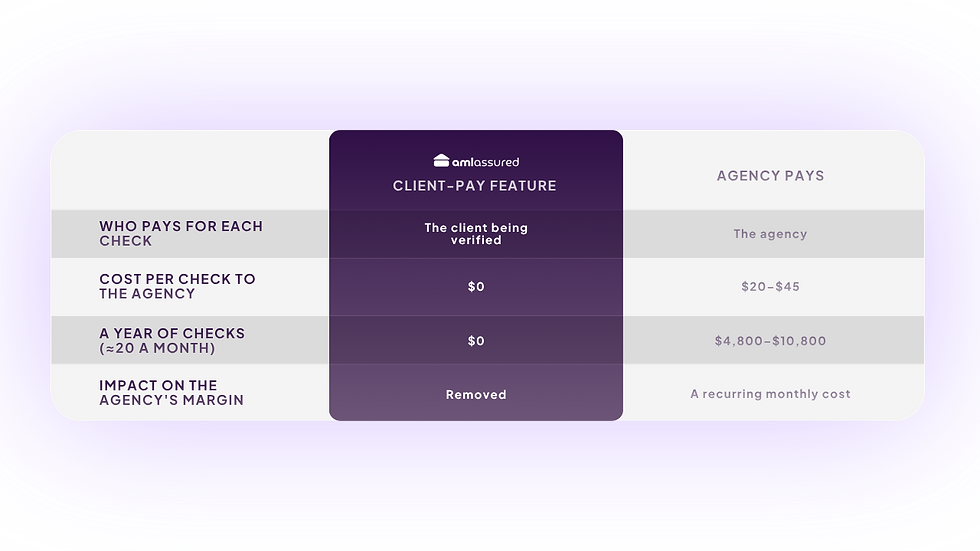
Take an agency handling twenty verifications a month - a modest figure for an active office once you count both sides of each deal. At $20 to $45 a check, that's somewhere between $4,800 and $10,800 a year in verification fees alone, sitting on top of whatever the agency already pays for its software.
For a large franchise, that's a rounding error. For the independent and boutique agencies that make up most of the market, many are already working on thin margins, it's a real line item that didn't exist eighteen months ago.
Where the client-pays model comes in
Property transactions already work this way in other places. Buyers and vendors routinely cover the cost of searches, certificates and disbursements that sit inside a deal. Identity verification is no different in principle; it's a cost of the transaction, not a cost of running the agency.
That's the logic behind the client-pays model now reaching the market. Instead of the agency absorbing each check, the person being verified pays for their own, as part of the process. The check still happens, the record is still kept, the requirement is still met. The only thing that changes is where the cost lands: with the transaction, not with the agency.
The effect on an agency's numbers is simple. A per-check cost of $20 to $45 becomes $0.
Why it matters now, not later
The timing isn't incidental. Agency revenue and profit have both come under pressure in recent years, and staff costs already account for the majority of most agencies' expenses. Any recurring cost that can be removed without cutting service is worth a look, and verification fees are one of the few that can be removed outright rather than merely trimmed.
There's a competitive angle, too. Agencies that treat compliance as a cost centre will feel it every month. Those that structure it well can protect their margin while meeting exactly the same requirements.
How AML Assured is applying it
At AML Assured, this is the thinking behind Client-Pay Verification, which is rolling out now. It's built specifically for real estate — not adapted from banking or legal software — and it works inside the tools agencies already use, including LockedOn, ARO and Forms Live. An agent sends a buyer's or vendor's check straight from the workflow they're already in. With Client-Pay switched on, the client covers the check, and the agency's cost per verification is $0.
The point isn't the toggle. It's what it says about how compliance can be structured: as something that meets the requirement without quietly eroding the margin underneath it.
The takeaway for agencies
The new rules aren't going anywhere, and neither is the need to verify every buyer and vendor. But the cost of doing it is more flexible than it first appears. Before committing to a platform – or staying with one chosen in a hurry before the deadline – it's worth working out exactly what you're spending on checks each year, and whether any of it needs to be yours to pay.
Speak with the team at AML Assured, to show you 1000’s of Aussie agents and agencies are utilising client-pay verification. https://www.amlassured.com/demo