
A falling market puts the portals to the test
Australian property has turned, and the businesses that connect buyers, renters and sellers are among the first to feel it.
Cotality's Home Value Index, released on 1 September, showed national values fell 0.9% in August. It was the fifth monthly decline in a row and left values 3.6% below the March peak, with Cotality finding that 93% of capital city suburbs recorded a fall through winter.
The Reserve Bank has lifted the cash rate by 100 basis points this year, at the time of writing, while the federal budget's changes to negative gearing and capital gains tax have moved many investors to the sidelines.
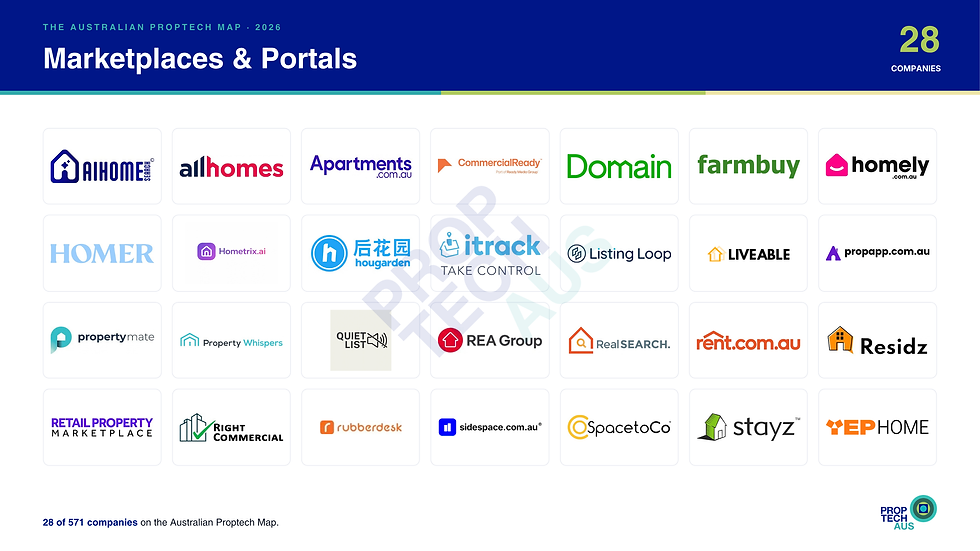
For the 28 businesses in the Marketplaces & Portals category of the 2026 Proptech Map, a falling market is not a quiet one. Homes still need to be sold, leased and found. And Australians have never had more ways to look for them.
More listings, slower sales
The shift is clearest on the listings pages themselves. Cotality counted capital city listings in the four weeks to 30 August running 2 % higher than a year earlier and 8% above the five-year average. That is not because more owners are selling. According to Cotality, new listings were actually 6% lower than last year. Stock is building because homes are taking longer to sell, with Cotality's median time on market stretching to 39 days, up from 28 a year ago.
The picture is uneven, too. REA Group reported that July listings on realestate.com.au fell 16% across Sydney and Melbourne combined, while Brisbane, Perth and Adelaide rose 13% as vendors there moved to lock in gains after a strong run.
For buyers, this is the most choice in years, and the fundamentals have not gone away. Reserve Bank Governor Michele Bullock told a parliamentary committee on 18 September that prices remain around 50 % higher than in early 2020, and that the market still faces a structural undersupply of housing.
Renters are feeling that shortage most: Cotality put the national rental vacancy rate at 1.9 % in August, well below the pre-COVID decade average of 3.3 %.
The two majors enter this downturn in strong shape. REA Group, the red team, reported on 6 August that FY26 Australian residential revenue rose 12% to $1.29 billion, even though national Buy listings were flat for the year.
The difference was yield. REA said what each vendor pays for depth products such as Premiere+ rose 13 %, and it has flagged a further 8% Premiere+ price rise for FY27.
Its audience remains its moat: a record 12.7 million Australians visit realestate.com.au each month on average, according to Ipsos iris.
Domain, the green team, is now part of US-listed CoStar Group, which completed its acquisition in August 2025 for around A$3 billion. In its second-quarter results, CoStar pointed to the AI search it has rolled out on Homes.com and Apartments.com in the United States, and to plans to launch its commercial marketplace LoopNet here.
Domain president Jason Pellegrino makes the case for the portal model plainly, saying public listing maximises buyer reach and "brings transparency to a campaign". Domain also owns Allhomes, a Canberra fixture since 2000.
The advertising bill sits between the two. When listing numbers stall and prices keep rising, the cost lands on vendors, and that is exactly the opening the challengers are pursuing.
Where the challengers are finding room
Around the two majors, our community has built genuine variety, and each business is pursuing a clear point of difference.
Off-market and pre-market. Listing Loop, PropApp, Property Mate and propertywhispers give buyers early access to homes before, or instead of, a full portal campaign. Quiet List works on the agent side, matching listings with buyer briefs. Its research, reported by The Sydney Morning Herald in March, found 20.2 % of homes in inner Sydney's harbourside council areas sold off-market in 2025.
PropApp founder Zac Burd told Real Estate Business in June that the downturn is accelerating the trend, and that off-market selling "is becoming the first step rather than a last resort".
Transparency and research. Homer surfaces hidden guide prices, campaign histories and agent pricing patterns, while “itrack Property” shows buyers what is happening inside a sale campaign. Residz lets people research more than 12 million Australian properties, Homely pairs listings with suburb reviews written by locals, and Liveable matches neighbourhoods to lifestyles.
AI-first search. RealSearch.com.au, Hometrix and AI Home Search are betting that conversational discovery will replace scrolling. RealSearch pairs its RealBot assistant with 3D aerial maps and says it was recognised in the Google Maps Platform Awards.
Specialist audiences. Rent.com.au focuses on renters and property managers, and HouGarden serves Chinese-speaking buyers across Australia and New Zealand. Apartments.com.au and YepHome concentrate on new and off the plan stock, Farmbuy covers rural and acreage sales, and Stayz serves the holiday rental market.
Commercial and flexible space. CommercialReady and the pre-launch RightCommercial target commercial investors and occupiers. Retail Property Marketplace brings retailers and landlords together, while Rubberdesk, Sidespace and SpacetoCo rent out desks, offices and rooms by the month, the day or the hour.
The next 12 months will test every one of them. If rates rise again and transaction volumes keep falling, vendors will look harder at what they spend on advertising, and agency principals will look harder at every channel that promises a result. That pressure rewards platforms that can prove their value, whether through audience reach, better data, lower costs or access to buyers nobody else can reach.
Bottom line: A falling market does not shrink this category; it sharpens it. With stock sitting longer and vendors watching every advertising dollar, the 28 businesses on this map are competing on proof.
For agents, principals, buyers and renters, the result is more choice than at any point in the history of Australian property, and that is a sign of a healthy ecosystem even in a year when prices are falling.
Marketplaces & Portals is part of the staged release of the 2026 Proptech Map. Is your company missing from this map, or listed in the wrong category? We want to hear from you at members@proptechaustralia.com.au.
We are releasing each of the 14 category maps as a static slide, but Proptech Australia members get the full interactive Proptech Map online, where they can search, filter and explore every company across every category.
For more information on becoming a member, go to https://www.proptechaustralia.com.au/signup. Or email our Member Specialist, Patricia Louise at members@proptechaustralia.com.au.


